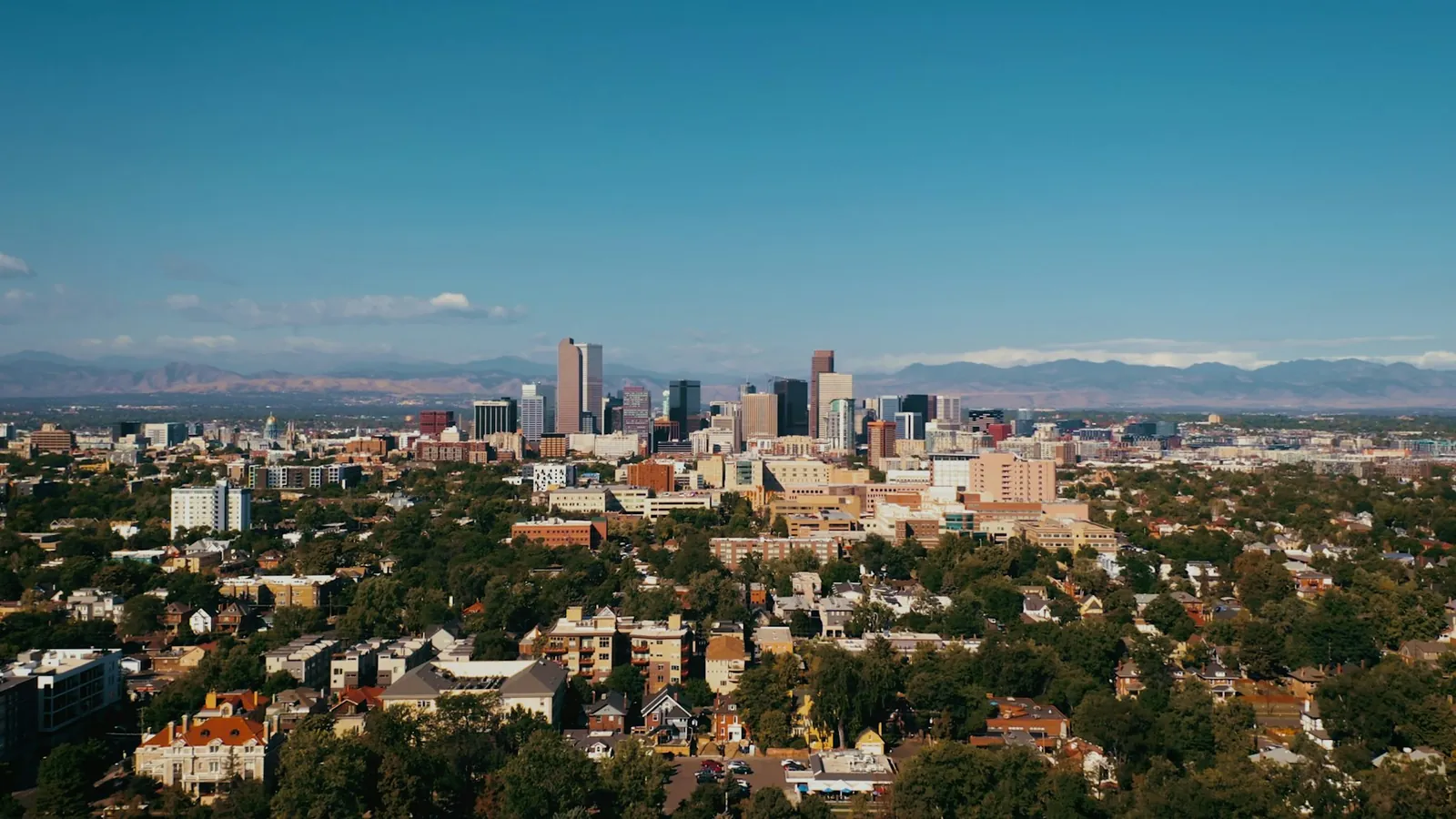
Fireplace and chimney service in Denver
Denver has more old brick chimneys than anywhere else in the metro. We inspect for free, photograph what we find and write the price down before any work.
About 61,000 Denver homes were built in 1939 or earlier, 16.9 percent of the city's housing against 7 percent for Colorado, according to the Census Bureau's 2024 survey. Another 17 percent went up between 1940 and 1959. Most of those houses have brick chimneys, many of them close to a century old, built for coal and wood and now often venting a gas furnace or water heater as well. The rest of the city is a mix of mid-century ranches, newer infill and a lot of apartments and condos with gas fireplaces.
Glendale is a small city in Arapahoe County surrounded by Denver, and its housing is almost all multifamily: fewer than 1 percent of its homes are detached houses, and more than half heat with electricity. There the work is mostly gas fireplaces and their vents. Across Denver itself, gas heats about 61 percent of homes. Both cities sit inside the state's no-burn area, so on winter Action Days an open wood fireplace has to stay cold.
What Denver's no-burn rules mean for your fireplace
From November through March the state forecasts air quality every day at 4 p.m. On an Action Day, Denver's code makes it unlawful to run a wood fireplace or stove that isn't approved, with a fine of $250 minimum and up to $2,000 per violation per day. EPA-certified Phase III stoves and inserts and approved pellet stoves are exempt, and gas fireplaces are not covered by the rule at all.
The state health department's FAQ says an open masonry fireplace may be used on an Action Day only if it's fitted with gas logs, an EPA Phase III insert, an approved pellet insert or an electric device. Gas logs typically run $500 to $2,000, a gas insert $2,000 to $8,000 and an EPA wood insert with liner $3,000 to $7,000.
Hail, freeze-thaw and the top of the chimney
NOAA's 1991 to 2020 normals count about 135 freeze-thaw days a year at the Denver-Stapleton station, roughly one day in three. Water in a cracked crown or open mortar joint freezes and widens the gap. Hail adds to it: the May 8, 2017 storm over Denver and Lakewood caused about $2.3 billion in damage and some 100,600 homeowner claims. We check caps, chase covers and crowns at the free inspection and photograph any damage for your insurance adjuster.
FAQ
Denver questions
Is the inspection really free in Denver?
Yes. We check the fireplace and chimney from the roof and from inside, take photos and write down the price of anything that needs doing before any work starts. If we need a camera scan to see a hidden problem, that is priced at the inspection. Cleanings are priced at that visit too.
Can I use my wood fireplace in Denver on a no-burn day?
Not an open wood fireplace. On Action Days only approved devices may burn: EPA Phase III stoves and inserts, approved pellet stoves and masonry heaters. Gas fireplaces aren't restricted. Check the forecast posted at 4 p.m. or call the state's advisory line at 303-758-4848.
I live in a condo in Glendale with a gas fireplace. Does it need service?
Yes. A gas fireplace should be checked once a year for the pilot, burner, glass seal and vent. At Denver's altitude it also needs to be set up correctly to burn cleanly, since gas appliances usually lose about 13 percent of their input here.
When can you come?
We book Sunday through Friday in 3-hour windows: 8 to 11, 11 to 2 or 2 to 5. We call ahead to confirm. We are closed Saturday.
Book online
Pick a day. We'll bring a ladder.
Free inspection in a 3-hour window: 8 to 11, 11 to 2, or 2 to 5. We call to confirm before we arrive.